


Modern military aviation has for years revolved around one question: how do you build an aircraft that detects the opponent first, takes the advantageous position first, and is the first to use its weapons? That logic is exactly what gave rise to 5th-generation fighters. These are machines designed not only with speed or maneuverability in mind, but above all with stealth technology, advanced avionics, sensor fusion, and the ability to operate in an environment saturated with radars and air-defense systems.
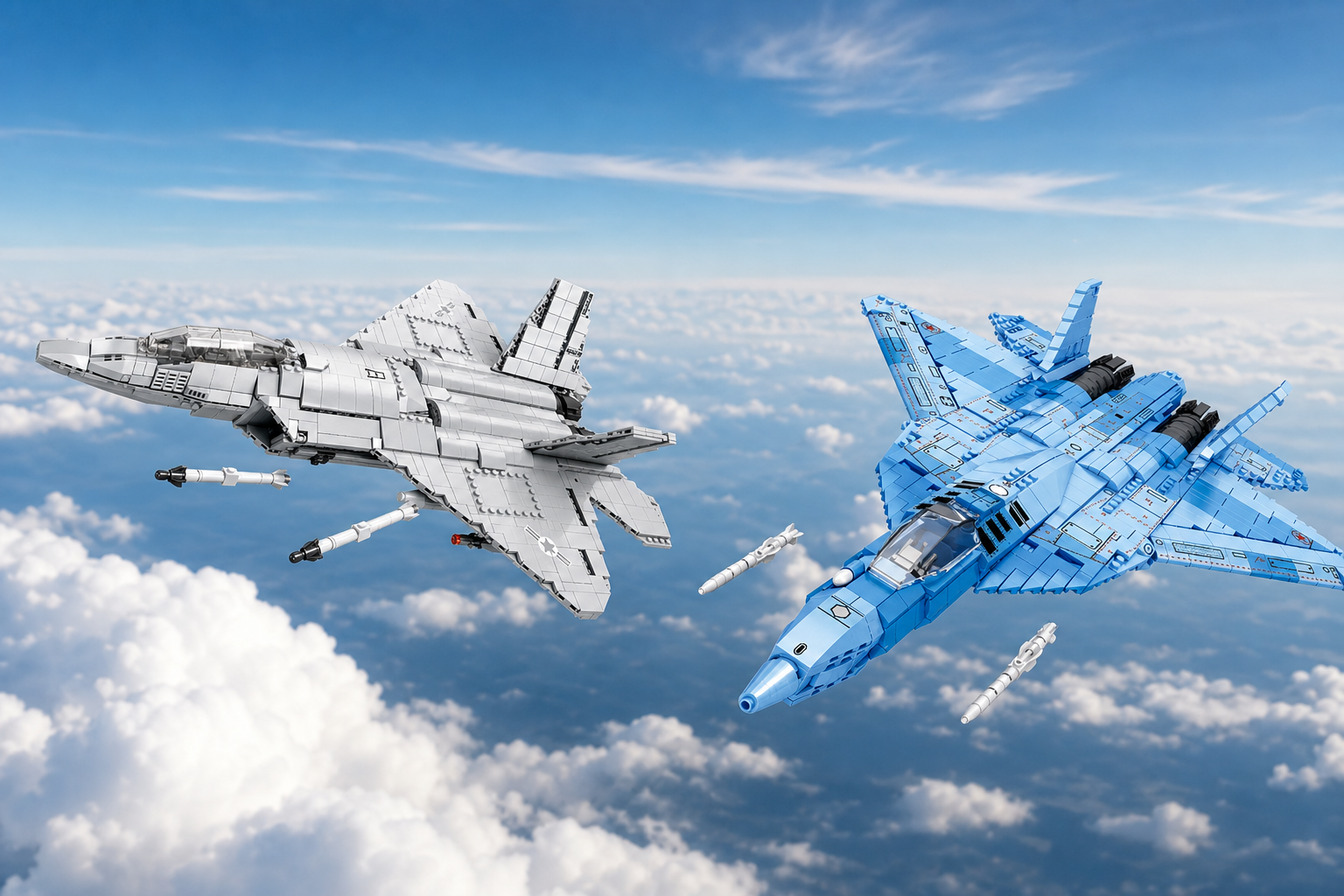
In the REOBRIX lineup, two models look particularly interesting and naturally lend themselves to being placed side by side: the REOBRIX 33020 F-22 Fighter Raptor and the REOBRIX 33030 SU-57 Sukhoi. It’s a great duo for a collection because it doesn’t pair random designs. It brings together two symbols of technological rivalry: an American icon of air superiority and Russia’s answer to the Western direction of combat-aircraft development.
F-22 Raptor – the aircraft that changed the definition of air superiority
The F-22 Raptor was created under the Advanced Tactical Fighter program, which began back in the Cold War era. The United States wanted a successor to the F-15 Eagle: a machine that would ensure air dominance in the 21st century. After the competition between the YF-22 and YF-23 prototypes, the Lockheed/Boeing design was selected, and the F-22 became the first operational 5th-generation fighter.
The key idea behind the F-22 was to combine features that had previously been difficult to fit into a single aircraft. The Raptor was meant to be hard to detect, capable of supersonic flight without afterburner, highly maneuverable, and equipped with avionics that let the pilot quickly understand the tactical situation. In practice, it wasn’t simply a faster fighter, but a platform built around information: sensors, data fusion, and first-shot advantage.
The REOBRIX 33020 model fits this story well. The set consists of 1,729 pieces, has a complexity level of 5/8, and once assembled measures about 52 x 40 x 16 cm. The model immediately shows the characteristic stealth geometry: sharp transitions, a flat profile, a wide fuselage, and angular lines. The manufacturer also included an opening cockpit, movable control surfaces, retractable landing gear, and weapons that can be displayed in different configurations.
Su-57 Sukhoi – Russia’s answer to the stealth era
The Su-57 originates from the PAK FA program, Russia’s 5th-generation aircraft project. Its first flight took place on January 29, 2010, in Komsomolsk-on-Amur. The design was intended to combine low observability, high maneuverability, modern onboard systems, and the ability to attack air, ground, and naval targets.
Unlike the F-22, which was designed primarily as an air-superiority fighter, the Su-57 has been described from the outset as a multirole aircraft. Its silhouette reveals an emphasis on aerodynamics and maneuverability: a wide fuselage, spaced engines, large lifting surfaces, and distinctive wing edges give it an aggressive, more dynamic look than the compact bulk of the F-22.
The REOBRIX 33030 SU-57 Sukhoi consists of 1,456 pieces and, once assembled, measures about 57 x 41 x 13 cm. It’s an interesting counterpoint to the F-22: fewer pieces, but a longer silhouette and a more pronounced fuselage line. The model features an opening cockpit, movable rudders and wings, externally mounted weapons, and detailed engines and air intakes. For a collector, the most interesting thing is that both models can be displayed side by side as two different approaches to the same idea.
Why pair them together?
The F-22 and Su-57 create a very clear blog narrative. It’s not just a comparison of the USA and Russia. It’s a comparison of two design philosophies. The American Raptor focuses on maximizing information advantage and low observability. The Russian Su-57 combines stealth with an emphasis on maneuverability and multirole capability. Both aircraft are answers to the question of what a fighter of the future should look like, but they answer it in different design languages.
In brick form, this difference is especially rewarding. The F-22 looks more compact, technical, and minimalist. The Su-57 is longer, more stretched out, and visually dynamic. The F-22 can be the central model in a stealth collection, while the Su-57 is the model that adds tension and a comparative angle.
The F-22 Raptor and Su-57 Sukhoi are one of the strongest pairings in the REOBRIX combat-aircraft category. What they share is a common theme: fifth generation, stealth, modern avionics, and the ambition to dominate the skies. What separates them is their design character, program history, and aesthetics. That’s why they work so well as a pair. On a shelf, they don’t look like two similar aircraft, but like two chapters of the same story about 21st-century aviation.