


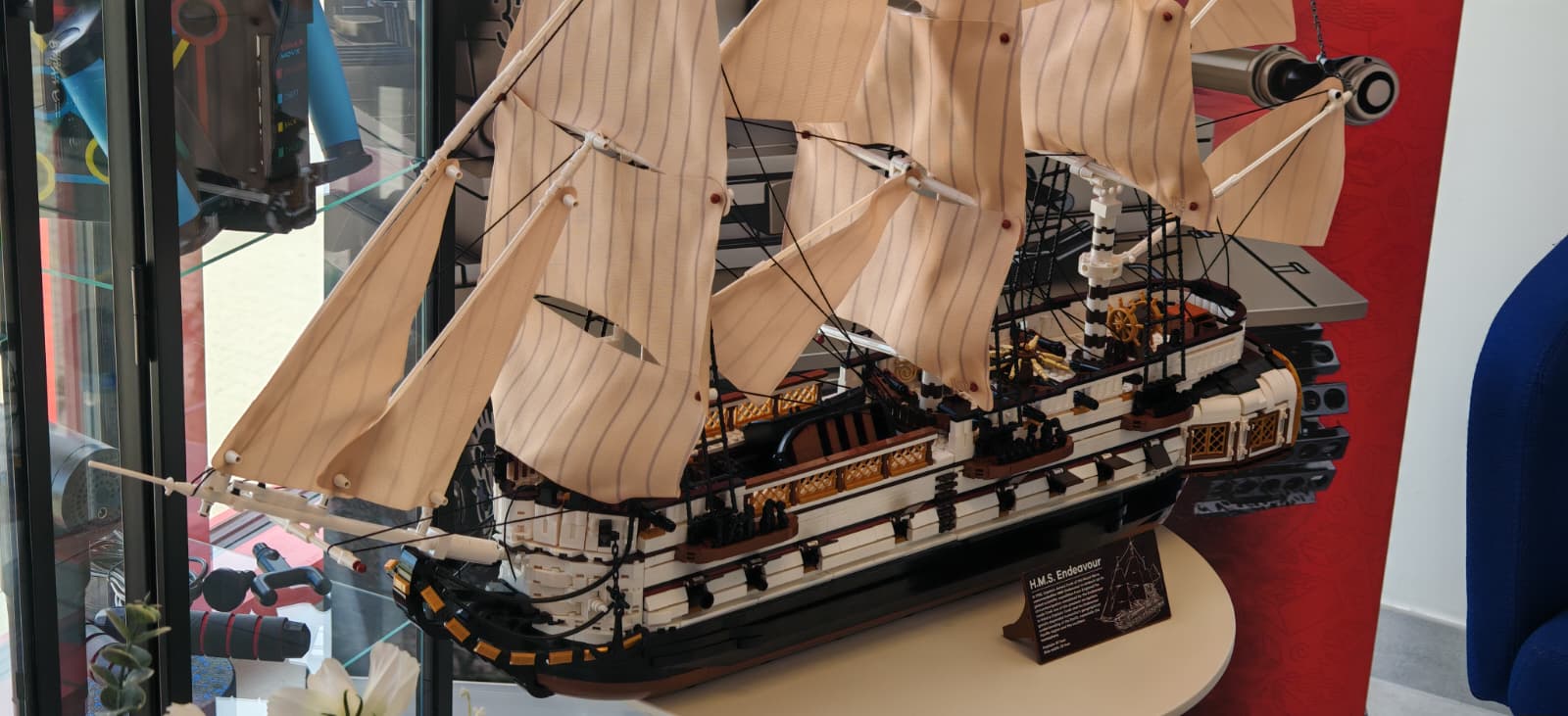
The ship crossed oceans, circumnavigated the Earth, took part in one of the most important scientific expeditions of its era, and literally came within a hair’s breadth of sinking on the Great Barrier Reef.
Interestingly, the vessel that became a symbol of the age of great exploratory voyages was not built with world discovery in mind at all.
From a coal carrier to a great expedition
Endeavour began its life far more modestly. It was built in Whitby in northern England and launched in 1764 as the Earl of Pembroke. It was a sturdy, broad merchant ship intended primarily for transporting coal. Such a design, however, proved perfect for a long expedition. The ship had plenty of space for provisions, was durable, and handled relatively well in shallow waters. In 1768 the British Royal Navy bought the vessel, refitted it at the dockyard in Deptford, and registered it under the name Endeavour. Its tonnage was about 368 tons. It’s worth explaining a certain curiosity here. Although the name HMS Endeavour is commonly encountered, historical sources often use the term HMB Endeavour - His Majesty's Bark Endeavour, because the Royal Navy classified the vessel as a bark.
August 26, 1768 – the start of the journey around the world
Command of the ship was entrusted to Lieutenant James Cook, who already had extensive experience as a navigator and cartographer. On August 26, 1768, Endeavour sailed from Plymouth – pronounced in English roughly “Plimeth” - beginning an expedition that was to last nearly three years. The official goal of the expedition was to observe an extremely rare astronomical phenomenon – the transit of Venus across the face of the Sun. The measurement was to be carried out on Tahiti and help astronomers determine more precisely the distance between the Earth and the Sun.
But Cook also had a second set of instructions.
James Cook’s secret mission
After completing the astronomical observations, Cook opened the Admiralty’s sealed orders. He was to sail farther south and search for a hypothetical vast continent referred to as Terra Australis Incognita - the Unknown Southern Land.
The best-known stage of Endeavour’s voyage began. The ship reached New Zealand, which Cook sailed around and mapped with remarkable accuracy, demonstrating that it was not part of the sought-after great continent. Endeavour then headed west. In 1770 the expedition reached Australia’s east coast. Cook charted the eastern coastline—previously unknown to Europeans on such a scale—stopping, among other places, in the area of today’s Botany Bay. There the expedition encountered Indigenous Australian communities whose lands had been inhabited for thousands of generations.
The night Endeavour nearly sank
One of the most dramatic events of the entire expedition took place on June 11, 1770. Just before midnight, Endeavour struck a coral reef belonging to the Great Barrier Reef. The hull was badly damaged, and water began pouring into the ship. The situation was critical. For many hours, the crew worked the pumps while also trying to reduce the ship’s weight. About 48 tons of equipment and ballast were thrown overboard, including six cast-iron cannons. After nearly a full day, Endeavour was freed from the reef.
That, however, did not solve the problem—the ship was still leaking. The crew used an old seafaring technique called fothering: a specially prepared sail packed with material was hauled under the damaged section of the hull, and under the pressure of the water it partially plugged the hole. This helped reduce the leak. Endeavour then reached a river later named the Endeavour River, in the area of today’s Cooktown. There the ship was hauled ashore and its hull repaired for several weeks. Had the construction of the former coal carrier been less robust, the story of this expedition might have ended right there on the Great Barrier Reef.
Endeavour really did sail around the world
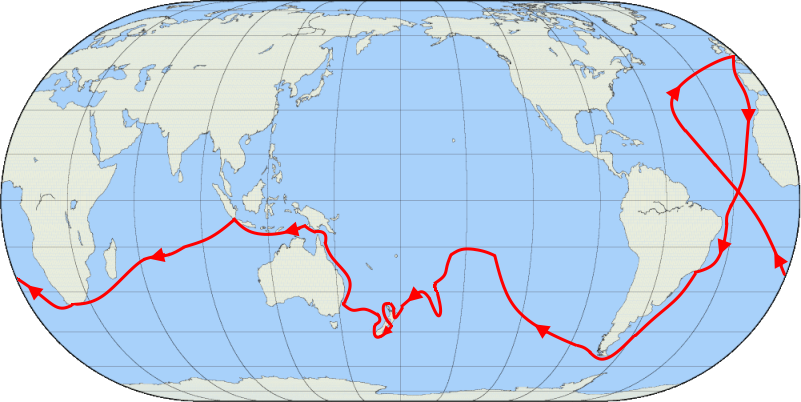
After the repairs, the expedition set out again. Endeavour sailed through the Torres Strait, reached the Indonesian archipelago, and Batavia – today’s Jakarta. The stay in this region had tragic consequences for the crew. Many fell ill with malaria and dysentery, and some died. The route onward led across the Indian Ocean, around the Cape of Good Hope, and then across the Atlantic to Europe. In this way, Endeavour circumnavigated the Earth. After nearly three years of travel, the ship returned to England on July 12, 1771. In a single voyage, this small 18th-century sailing ship thus covered a route from England across the Atlantic, around Cape Horn, onward through Tahiti, New Zealand, and Australia, then through Southeast Asia, the Indian Ocean, the Cape of Good Hope, and the Atlantic once again.
What happened to the real Endeavour?
Cook’s great expedition was not the end of the ship’s story. After its service ended, Endeavour was sold to a private owner and renamed Lord Sandwich. Later it again found itself in service connected with the British fleet during the American War of Independence. In 1778 it was deliberately sunk in Newport Harbor in Rhode Island, along with other vessels used by the British to blockade the port. Remarkably, more than 240 years later, archaeological research made it possible to identify the wreck designated RI 2394 as the remains of the former Lord Sandwich, i.e., Endeavour. The Australian National Maritime Museum presented the results of many years of archaeological and archival research confirming this identification.
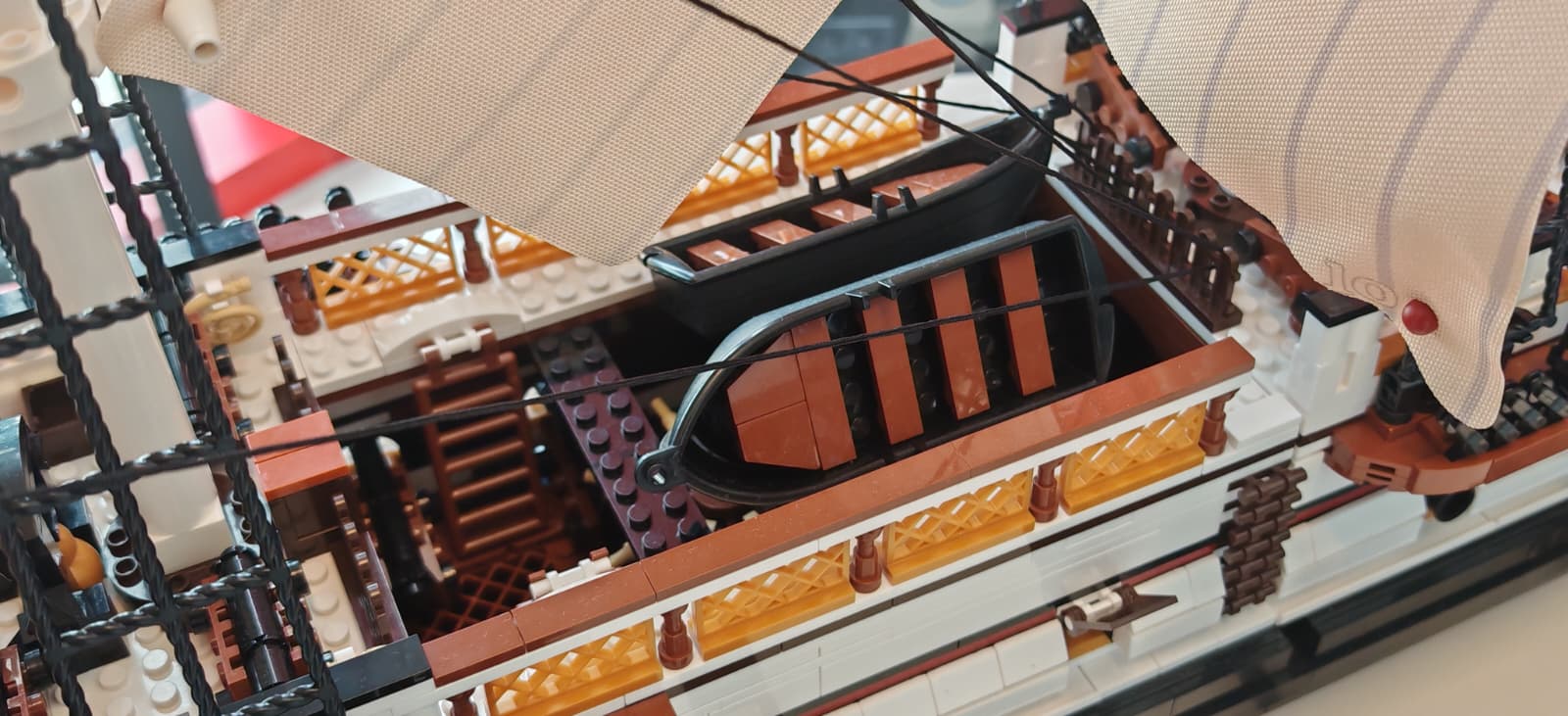
A sailing-ship legend you can build with bricks
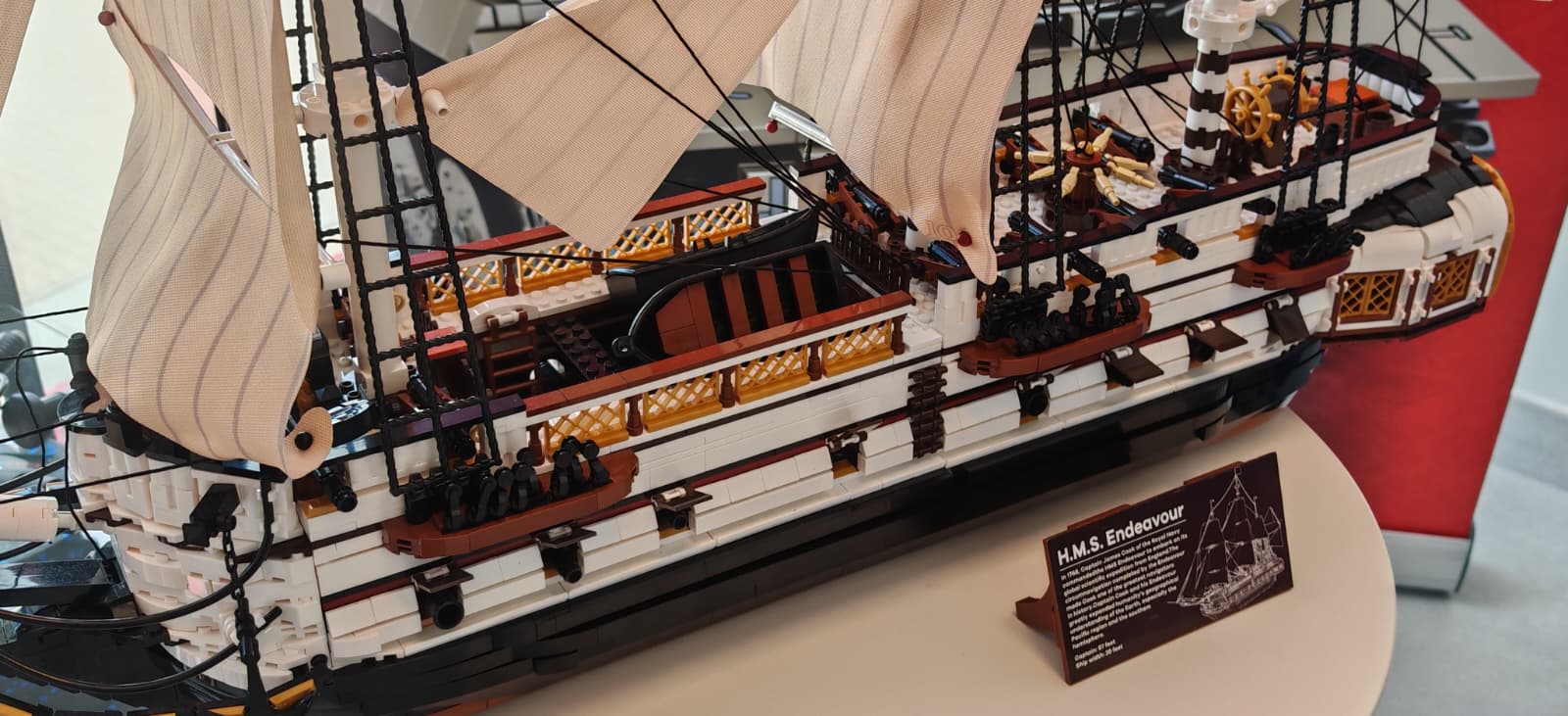
Endeavour’s story means it’s not simply another impressive sailing ship. It’s a vessel connected with one of the most famous sea voyages of the 18th century—an expedition encompassing astronomy, cartography, Pacific exploration, a dramatic fight for survival, and ultimately a journey around the world. And it is this historic ship’s silhouette that the REOBRIX 66048 Endeavor sailing ship refers to.
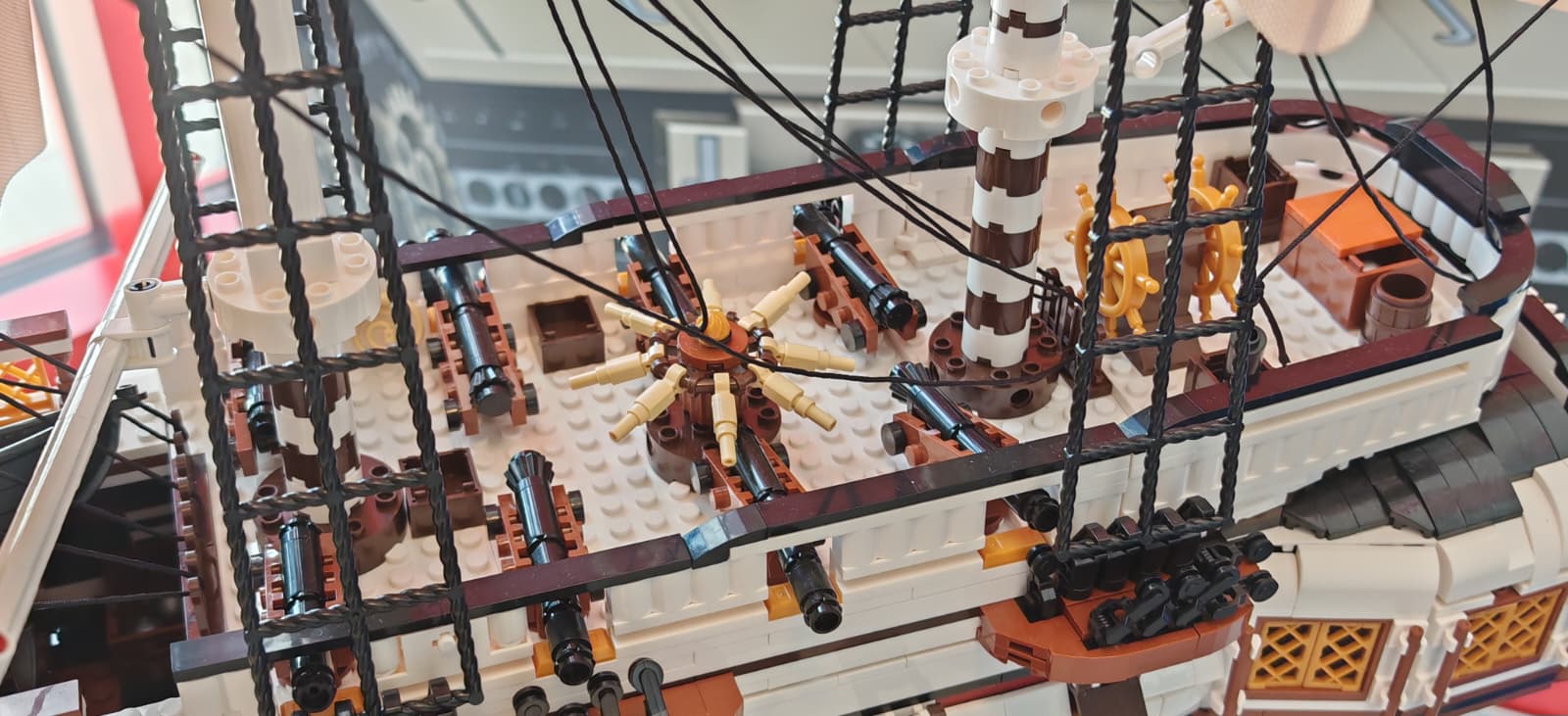
The model consists of as many as 3555 pieces, and once completed it reaches an impressive 109 cm in length, 25.9 cm in width, and 73.6 cm in height. This is no small desk model, but a full-fledged collector’s sailing ship that can become the centerpiece of a display. REOBRIX also took care of the elements that build the ship’s character: an expanded deck, masts and rigging, anchors, railings, a ship’s wheel, barrels, portholes, and large printed sails. The design is modular, which makes assembling and later moving such a large model easier. The manufacturer rates the difficulty at 6/8 – expert, so 3555 pieces should provide many hours of building. The set is intended for people aged 14 and up, but due to the scale and nature of the model, it will work especially well in the collection of an adult fan of sailing ships, history, and large brick-built constructions. Importantly, the model is not a set licensed by an institution associated with the historic ship—it is a REOBRIX design inspired by the silhouette of the British Endeavour.
See REOBRIX 66048 Endeavor sailing ship – 3555 pieces
From Plymouth all the way around the world
Endeavour began as an ordinary coal-carrying merchant ship. A few years later it sailed from Plymouth on a voyage during which it crossed oceans, survived a nearly catastrophic collision with the Great Barrier Reef, and returned to England after circumnavigating the entire globe. Today, its story still fascinates—also because behind the monumental silhouette of an 18th-century sailing ship lies a tale of navigation without GPS, months-long voyages through unknown waters, scientific curiosity, and a crew that at a critical moment saved their ship from sinking. And if, instead of only reading about Endeavour, you want to see its distinctive silhouette on your own shelf, the 109-centimeter REOBRIX 66048 is one of those models where the build itself can become a small expedition—fortunately without the need to spend three years at sea.